by Rob Morgan
It’s certainly true that no-one will ever again see a battery of Gribeauval 12pdr field guns in action, sit mounted in a charge of Lancers, nor, thankfully, be part of a Forlorn Hope. As wargamers, we can only imagine, and attempt to develop, rules and table-top tactics which reflect our vision and the reminiscences of military diary-keepers and historians from long ago.
Though there does exist a sturdy, if only too small, body of men and women from whom we can learn much of those skills and the problems which beset the footmen, sappers and cavalry troopers of earlier times.
These are reenactors.
As wargamers too, we should stick close to our brethren in reenactment – they can teach us a lot, not only about tactics, but about the simple things, like moving in full kit, and ( don’t laugh, this is true) marching with a blister.
They know about the equipment, the weapons and the problems which one of Bonaparte’s Voltigeurs or a Great War gunner faced.
I try to go to as many reenactment events as I can (though age is against me carrying a pike these days), take photos and talk to the participants. I’ve learned a lot over the decades, and its helped me not only with gaming, but with my writing as well.
Of course, I don’t know how many SWA members are reenactors, or attend events, because sadly we have too few reports (well, none) of staged battlefield encounters. It’s a rarity to see any photographs of reenactments in this splendid blog thing of ours.
So, here are a few photographs of soldiers from a war I have actually gamed- well, the naval part of it, anyway: the Spanish-American War 1898.

If you game it, you’ll know the Osprey Men-at-Arms 437, by Alejandro de Quesada. These reenactors were photographed at Expohistorica at Castellon in Spain over a decade ago, by my colleague and friend Jaime de Miguel of Madrid.
They are dressed as infantrymen of a Spanish Regiment in Cuba, and wear the blue and white striped rayadillo uniforms which look like ticking.
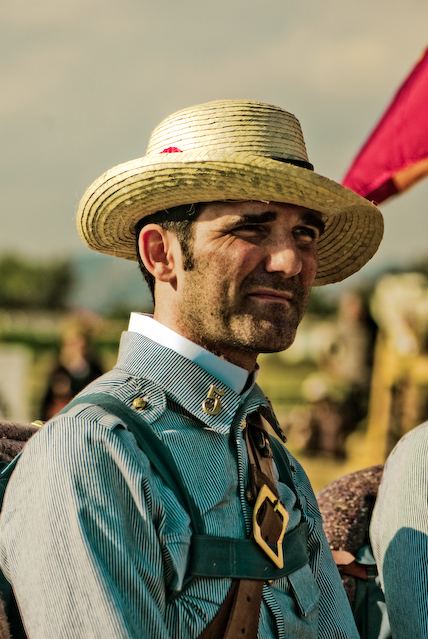
The kit is a mixture of local and national equipment items, and the hats are the unfortunately named straw jipijapa, with a unit and arm of service badge on it.
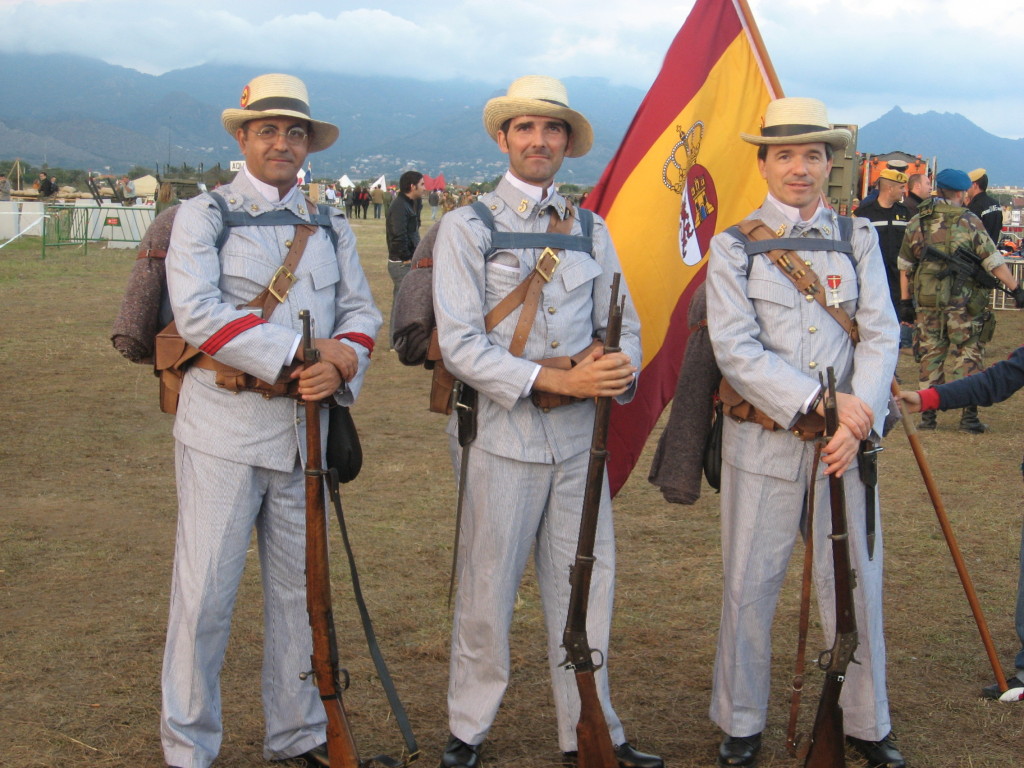
The weapons are Mausers, though some used Remingtons. The corporal carries his red rank stripes on his lower sleeves.
Not too difficult to paint as say 15mm or 20/25mm figures, but the material must be hard to reproduce in paint in the larger 54mm scale.
The uniform, and gear apparently, was described as comfortable.
Hi Rob,
Very interesting post. As luck would have it, a few days before your post I was speaking to a work colleague about his weekend, to find that he’d gone to a re-enactors get together. His group are into firing black powder weapons, most are collectors. His contribution to the camp fire chat, come show and tell, was to talk about military history, uniforms etc as most in the group are more focussed on the weapons themselves. His group is apparently associated with a parent group in the UK, based on the 95th Rifles during the Napoleonic wars. I think there are two 95th Rifles groups in Australia, his being one of them. One of the key areas of research are the tactics and drill in use at the time, and ensuring this is captured, articulated in the group’s manuals and performed correctly in the field. During their get togethers, some members will also camp in period dress using period tents and equipment. There is a fair bit of competition on authenticity apparently!
One point that struck home during our discussion tied in with your comments on how the experiences of re-enactors can enrich our hobby was a situation that was described during a large scale event. In this case, a mock battle was underway with the Rifles out skirmishing against the French infantry, during which my friend noticed some French cavalry about 500 yards off on the flank, too far away to be a threat! He turned his attention back to loading and firing against the ‘enemy’ infantry when suddenly there was a call to ‘form emergency squares’! He and three others just had time to clump up and present bayonets when the French cavalry thundered through their formation waving swords and making a right nuisance of themselves as is their want!
Key points, the cavalry were originally observed at what was assumed a ‘safe’ distance, but the cavalry closed that distance in surprisingly quick time! Most importantly, they were not heard approaching, but were luckily spotted just in time for someone to shout out the warning.
All of this occurred during the noise and smoke of what would have counted as a very small skirmish by Napoleonic standards, in the smoke, noise and confusion of a full scale battle, I wonder how comparable situations would have played out? I suspect that soldiers of the day would have had a much better idea of how fast cavalry could move, so perhaps would not have been caught out as easily as our brave re-enactors were?!
Again, I suspect a key skill cavalry commanders of the day would have had was to use the terrain to mask their approach to a target as much as possible?
On the tabletop, the terrain is highly abstracted, but I suppose this is where the random effect of die rolls helps simulate the effects of such minor tactics. The reason your cavalry didn’t charge when required was that there was a bog to their front due to low lying ground, etc. The reason your infantry didn’t form square when approached by cavalry was that they were in a slight depression, filled with musket smoke and too focussed on firing as fast as possible at the enemy to their front to notice the enemy horse approaching their flank.
The helicopter view, perfectly manicured grass surfaces and minimalist foliage of our tabletops is a far cry from real world topography and a historical commander’s situational awareness!
Again, this is another reason I prefer to solo game, rather than watching my opponent curse his dice because his troops didn’t do what he wanted them to do, etc.
Thanks for another thought provoking post!
Cheers
GB