As indicated in my post on the Battle of Bingen, I was somewhat surprised at how deadly the massed Prussian artillery proved to be, which effectively stopped the French counterattack dead in its tracks in one round of firing.
I had a chance to look back over the action and found, as expected, that I had made a “ahem, ‘little’ mistake.” Hence the title to this post.
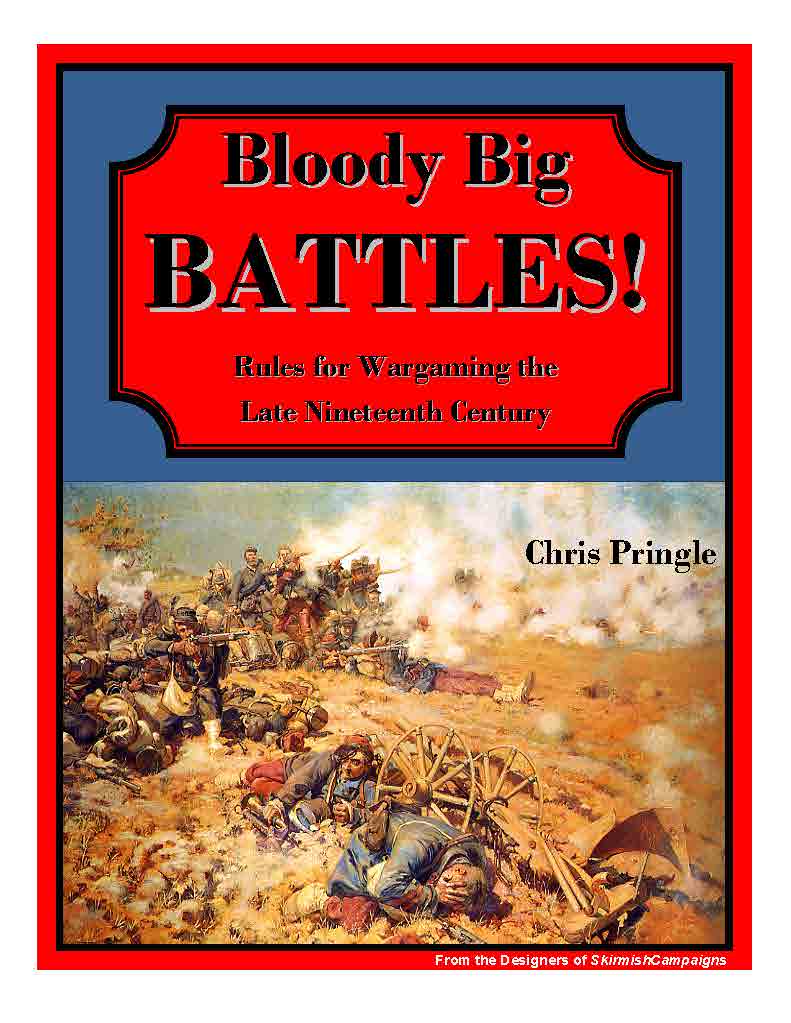
As I explained in my article in Lone Warrior 222, I am using two sets of rules, Bloody Big Battles (BBB) by Chris Pringle, and 1871 by Bruce Weigle for my Bavarian campaign.
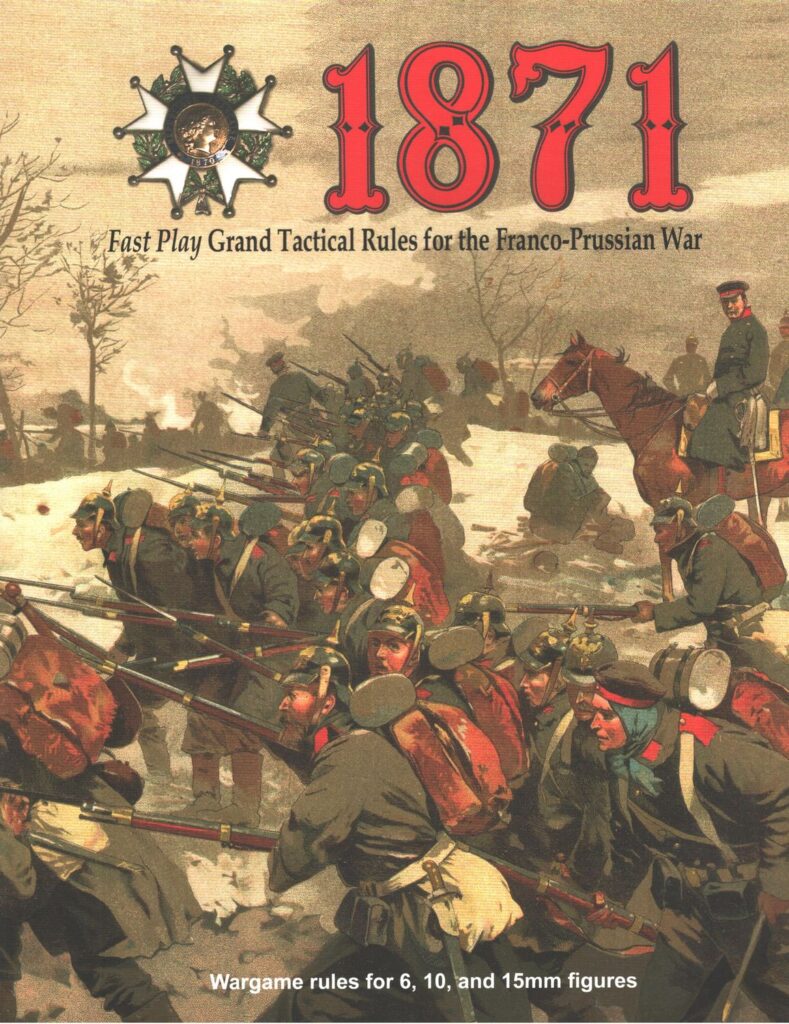
I bought Bruce W’s rules a while ago and all my forces are based and organised in accordance with his guidelines.
A single base of infantry in 1871 represents a battalion, three battalions (bases) comprise a regiment, whilst a single artillery base represents a battery of six guns. Two infantry brigades (four regiments) make up a division and, for the Prussians, two divisions make up a corps.
BBB are geared towards very large battles (hence the name), and in order to fit such megabattles on a dining table-sized playing surface the smallest unit being moved on the table is a brigade (compared to a regiment in the 1871 rules).
What this meant for me, was a really elegant situation where I could literally split an 1871 organised corps in half and have sufficient bases to field two corps under the BBB rules. However, it was this (overly) simple solution that proved to be the undoing of the French at Bingen.
In a nutshell, the Prussians had 14 artillery batteries in their corps structure, which were all represented via the 1871 basing and orbats.
Splitting the Corps down the middle to create two corps under BBB, meant each of the new “corps” had seven artillery bases, and I assumed that each base would represent two 6-gun batteries. Unfortunately, I had failed to notice that in BBB, an artillery base represents four (FOUR!) 6-gun batteries!
I think you can see where this is going now!
So, when the Prussians concentrated most of their artillery batteries in the centre of their battle line, what I saw was six bases or 12 batteries. However, in game (and firing factor) terms, what was actually there was the equivalent of 24 artillery batteries or 144 guns!
Small wonder that when the French 2nd Brigade, 1st Division, 5th Corps, stepped off into the attack with drums beating and flags waving, it effectively became the sole target for 144 pieces of Prussian artillery and was promptly annihilated in its tracks.
This reminds me that I really need to develop some appropriate rules for casualties!
Until the above-mentioned incident occurred, casualties on both sides had been accruing in dribs and drabs due to the cumulative effects of rifle fire and occasional artillery hits. These sorts of results could be described as typical, and there are a variety of guidelines available for determining the ratio of KIA/WIA/POW after a battle in this context.
For a campaign, casualties are very significant as they affect forces available and their status for future battles. I am wondering now how I generate the casualty ratios for an ‘artillery hell’ as described above.
The easy option for Bingen is to gloss over the details of the casualty results and just say that the French and Prussians fought each other to a draw, with equal losses to each side, and work out the casualty lists as for a ‘typical’ battle. The artillery mismatch would never have occurred if I’d used the BBB figure/base ratios in the first place, which incidentally would have meant the Prussians would have only fielded three artillery bases on the table, not the seven I gave them.
For the Bingen post-battle results, I will treat the battle as a ‘typical’ engagement, as that is what it should have been in the first place. However, I have no doubt that when I have armies of several corps on the table, massed artillery will probably be a recurring feature, so I’m going to have to work out how to deal with more, and probably even larger, ‘artillery hell’ scenarios.
In the meantime, Bingen shows what can happen when one doesn’t pay attention to what one is doing, and inadvertently strays into steampunk territory with magazine fed, auto-loading rifled artillery suddenly making an appearance (or rather, finding one’s artillery is behaving as if they did!)
So, a valuable lesson learnt, and also a grim portent for the future, in more ways than one!
Congrats, George…get down the Patents Office, pronto!!
I have often wondered about the representation of artillery in BBB….there’s a really good groups.io site for BBB, with superb scenarios written for the rules set, but on first inspection artillery seemed to be under-represented. Now you’ve highlighted the rules difference that explains why!! I have Weigle’s 1866 but have yet to acquire BBB, so your discovery of the artillery piece to model ratio has cleared that up for me
G’day Martin,
Great to hear from you!
Yes, I think I have a war winning and most profitable invention there that will make Herr Krupp, and the armaments industry in general, green with envy and have every War Ministry on the planet knocking on my door!
Agree that the BBB artillery representation appeared a bit light, it’s even worse for the Mittraileuse batteries which are listed in the BBB French corps orbats as 0.5 bases! Now, I don’t care how good the rules are, I’m not chopping any bases in half just to play them!
I figured out, after my Bingen battle that what was probably intended was that you apply 0.5 x Fire Factor for the Mittrailleuse and add that to the shooting total you’re working on. I’ll use my Mittrailleuse bases (intact) to represent which unit has the weapons attached.
If you do get the BBB rules I’d be keen to hear your take on them?
Many thanks for the heads-up on the BBB site, I’ll definitely check that out!
Cheers
G