
by Rob Morgan
The questions about fittings, rigging, etc. on models of warships in the Ironclad era bring a few thoughts to mind.
If you’re gaming solo, and are a dedicated model-maker, then super detailing your models in whatever scale is a splendid option. If, however, like me over the long years, you sometimes have to accommodate learners, novices to naval warfare, and the odd group, then the super detailed model becomes a nightmare to guard from damage or destruction.
If any of these scenarios face me, I tend to use models like this one, a basic one piece, resin 1/1200th model of the 1871 Royal Navy turret Ram, HMS Hotspur, which in my coastal fleet has fought off French, Russian, Italian and Yankee attacks over the past three decades.
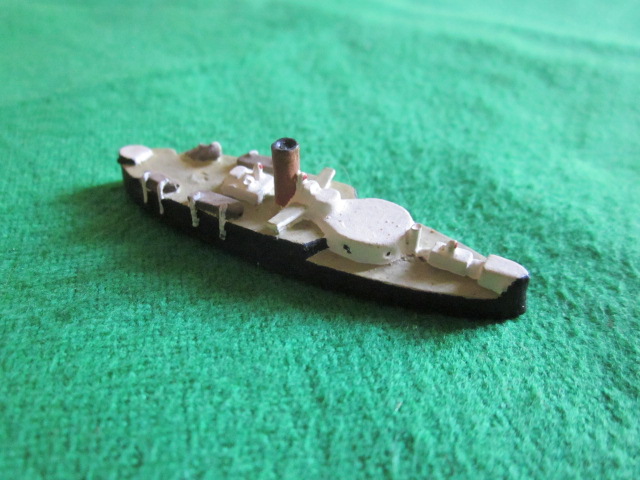
One problem with the early ironclads, turreted or broadside, was the top hamper – not only masts, sails and ship-rigging (on some), but anti-torpedo nets and booms (on most).
These are not at all easy to represent on the tabletop, yet, if you are using a warship which is stationary, essential.
These nets took time to set, and longer to gather, in inshore or harbour actions they could hamper any heavy unit to the point of making the ship very vulnerable. I use a removable card base, actually a blue-grey paint shop sample, laid under each hull, with the nets and booms inked in.
Quick and easy.
The small and fast torpedo boat was rightly feared. Remember the effect that fishing boats, taken in darkness for torpedo craft, had on the Russian fleet passing through the Straits of Dover in 1904!
If you are wargaming this era, then remember the ram!
Every capital ship in almost all nations was armed with a ram up to the launch of HMS Dreadnought. Training and tactics treated the gun, torpedo, and ram almost equally.
The victor of the Battle of the Falkland Islands, Admiral Sturdee wrote a detailed essay on this in 1894, and a decade earlier (1884) Admiral Elliot wrote The Ram-the prominent feature of future naval tactics. There were no major naval encounters between Lissa (where the ram proved successful) and the Russo-Japanese War, but had there been, then “close the enemy and ram” might have been a crucial tactic.
The Dutch navy, incidentally, built a number of Monitors which were gun and ram armed, and might have been tremendously effective in riverine waters.
Hi Rob,
Have been meaning to respond for a while now but thought to give others the chance to comment, …..
Am very much taken by the look of your HMS Hotspur, and I acknowledge all you’ve said about the focus on ramming and torpedo boats in the period.
If there is a copy of Admiral Sturdee’s treatise on ramming, I’d love to be able to read it. If I recall correctly, Sturdee was widely regarded in the RN as a master tactician, so his views on ramming would be interesting to say the least!
Again, I acknowledge your comments on ironclads of the period and the top hamper of sailing rig, especially for ocean going vessels. I definitely see practical advantages to running with coastal defence forces. As stated, I very much like the look your Hotspur model, so the puritanical side of me is keen to use ships of the 1870’s period. The practical wargamer voice is speaking in my other ear highlighting how much easier pole or military masts are to model, it’s only a matter of a few decades difference, etc ….
I’ll most probably end up getting fleets of both iron clads and pre-dreadnoughts, and game both periods.
Who can argue against more toys, especially when they’re ships!!!
Cheers
G