I want to thank Rich for selecting Convoy on the North Atlantic as the new “Sample Article” in the Lone Warrior blog. I hadn’t played the game in a few years, and it was like playing it for the first time. I have played the game three times since it appeared on the July blog—just in case someone asked a question, of course. The first two games were difficult because I forgot to add the extra AP to the roll of the Allied destroyer escorts. The Germans easily won the first game and the Allies barely won the second game—all the ships on the table were sunk but for one destroyer (the Lone Warrior?). I decided to make some changes in the third game, and I am glad I did.
Not everything was changed, however. The old grid of two-inch squares and the rules remained basically the same (I just remembered to give the destroyers a bonus AP on each roll). The only changes to the rules was the number of cargo ships on the board and the objective to win.
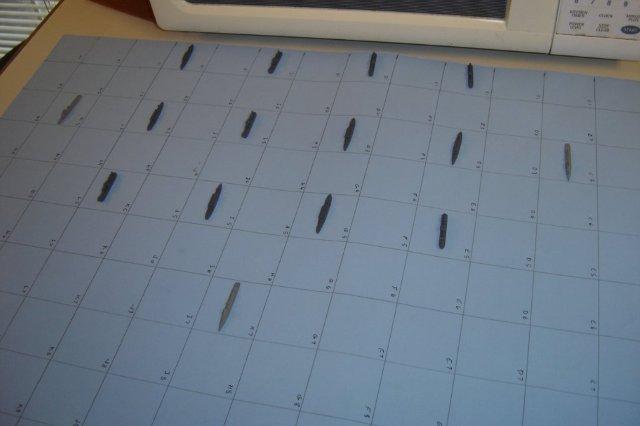
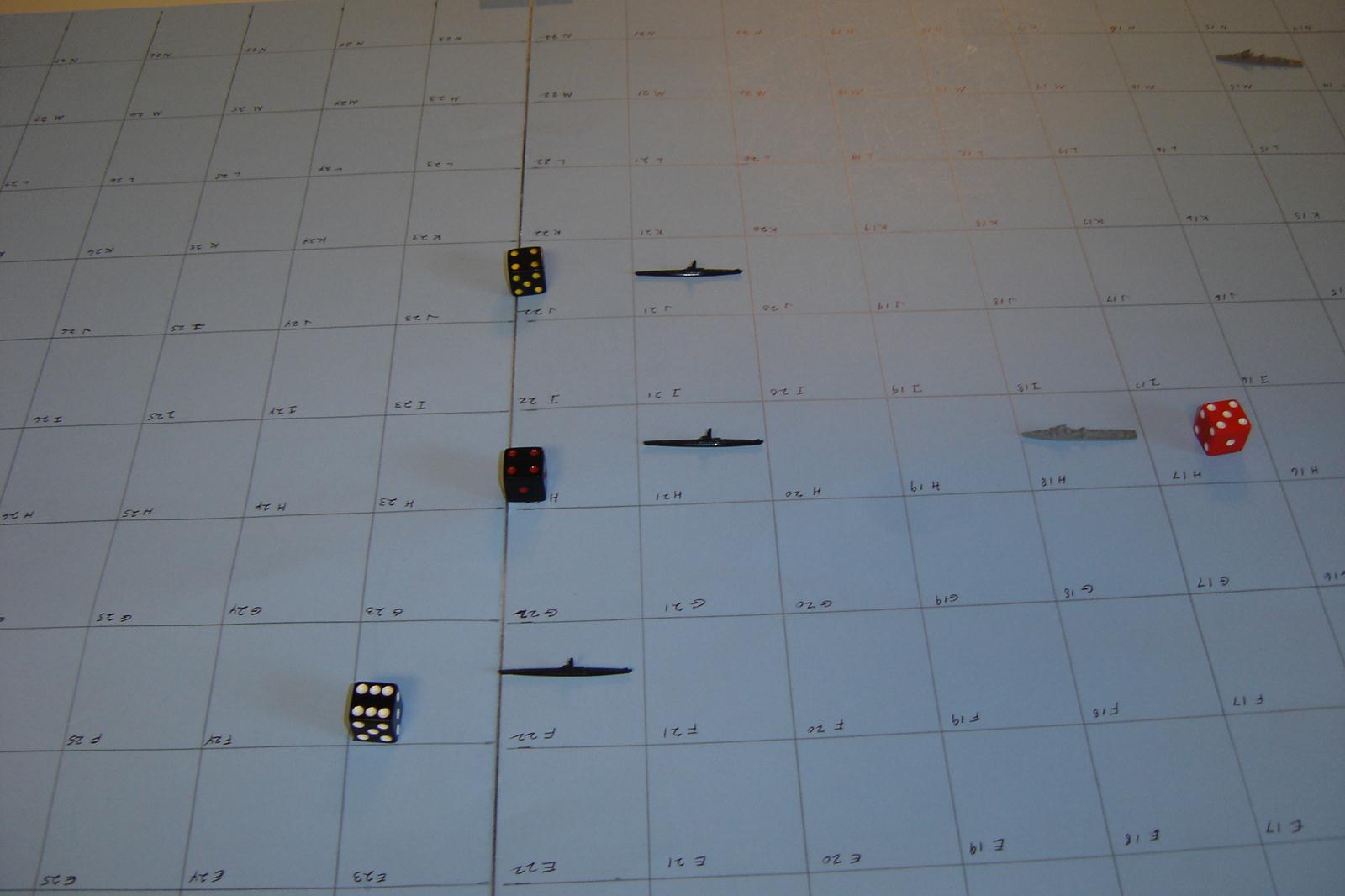
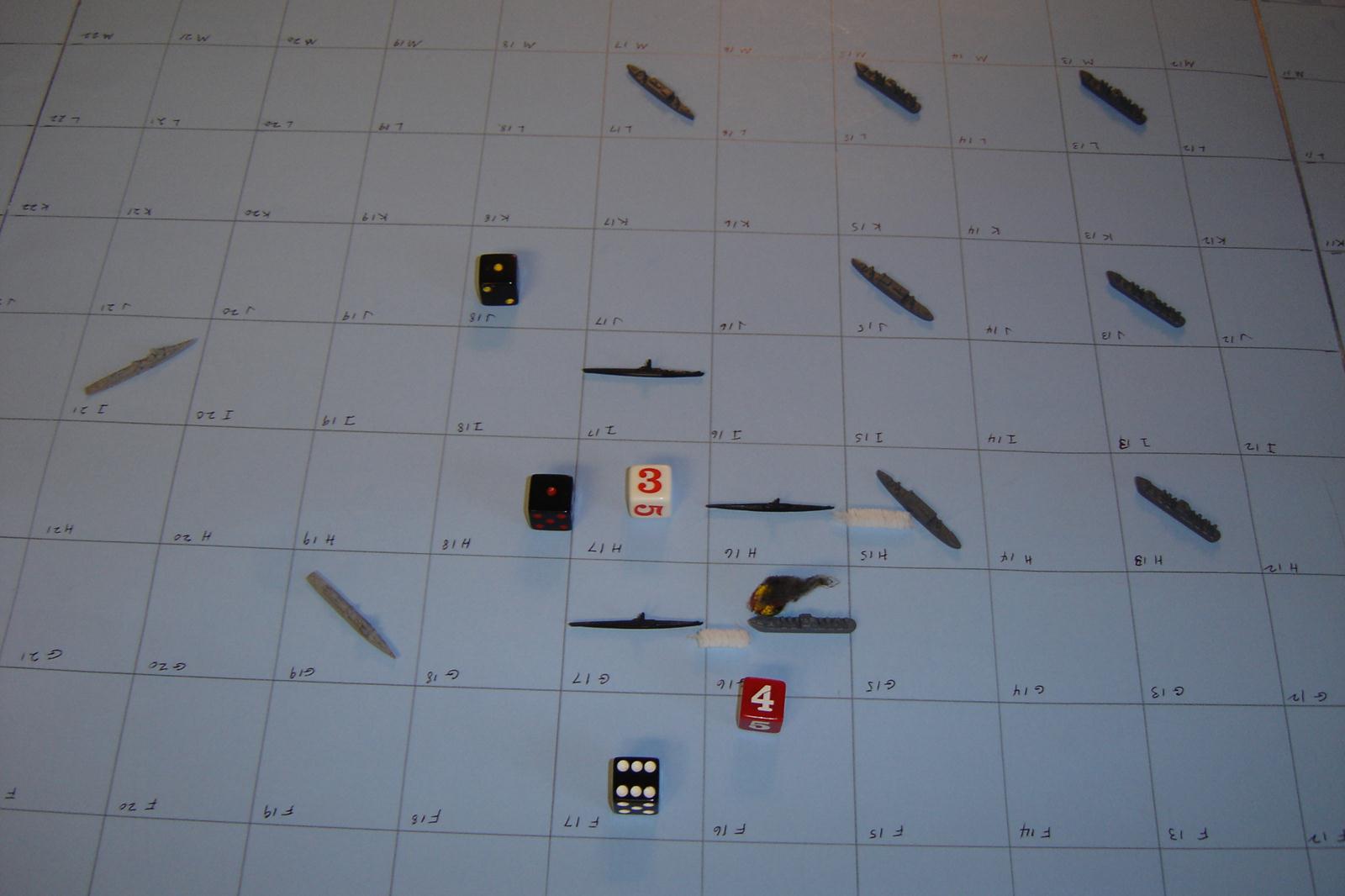
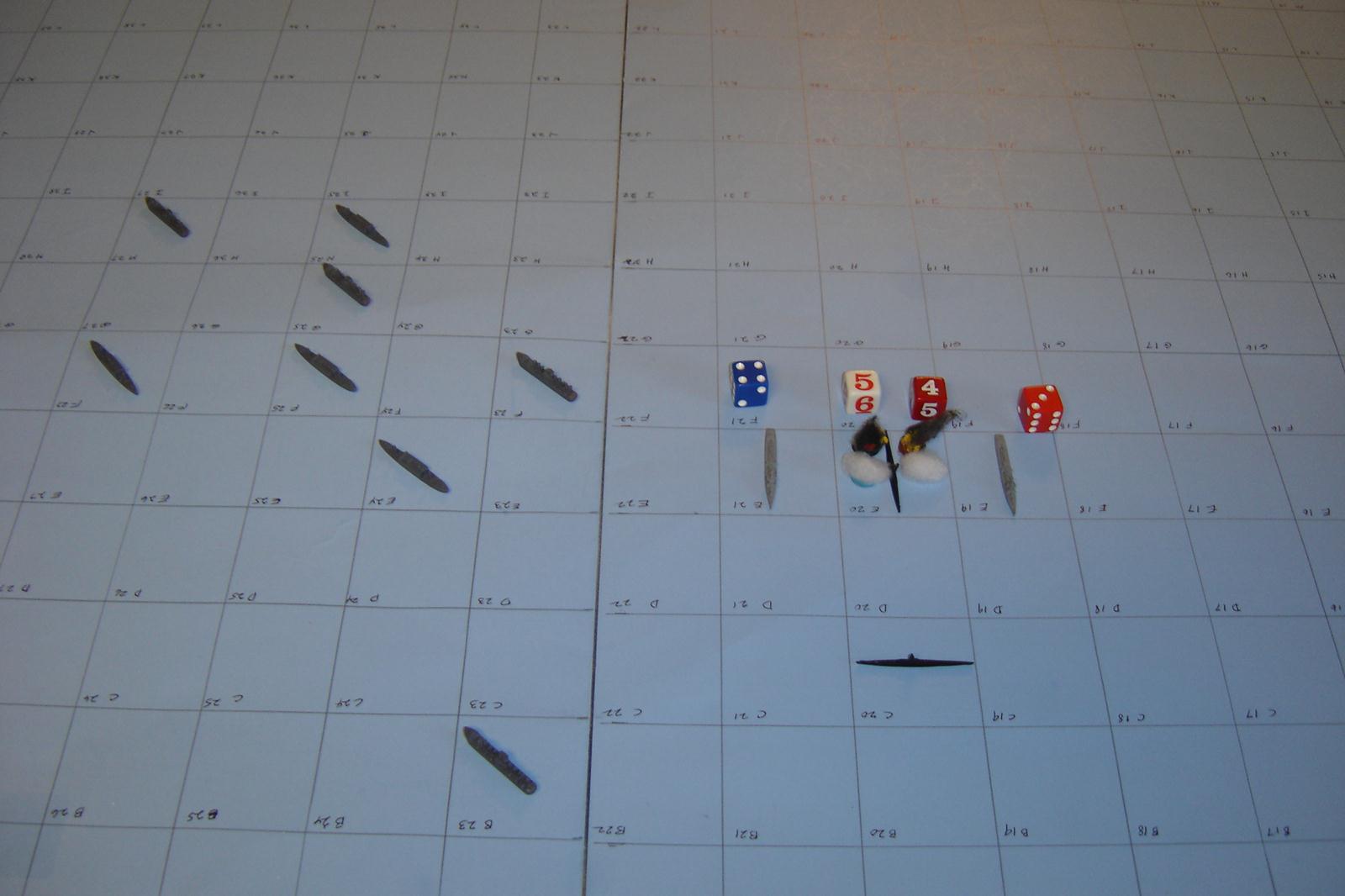
(Photos below.)
Some changes were made in the dice selection. Three black dice were rolled simultaneously for the German U-boats. Each had differently colored pips: white, red, and yellow. Likewise, the Allied destroyers were represented by three differently colored dice: red, white, and blue. The attack dice had Arabic numerals and were colored red, white, blue, yellow, and green.
Markers from older naval games were used to record the attacks and results of attacks by the submarines and destroyers. (I call them memory aids.) White pipe cleaners marked the trails of torpedoes and cotton puffs painted black with red and yellow flames marked a hit. Depth charges were indicated by puffs of white cotton glued to washers. Washers with black smoke and fire were used to indicate depth charge hits also, but small washers painted blue or red would have been more appropriate since the hit was under water and a sub did not sink with just one hit. (That will be a change for the next game.) When the results were noted on the score sheet, all of the markers were removed from the board.
The most noticeable change was the ship models. I used submarines, destroyers and cargo ships from the original Axis and Allies game and
the new Axis and Allies: Spring 1942, the World Is at War. The ships are not all exactly 1/4800 scale, but they all fit within the board’s two-inch squares and they all looked authentic.
Because the ships looked smaller than the cardstock paper models, it seemed that the convoy should be larger. Therefore, the number of cargo ships was doubled from six to twelve—from two rows with three ships in each row to three rows with four ships in each row. Since there were now 15 target ships in the Allied convoy, the new objective for the three German U-boats was to sink 10 ships—1 more than before. The Allies would win if the Germans were prevented from sinking 10 ships before the convoy crossed the opposite edge of the playing board.
In the third game, the Allies won 9 to 5. It could have gone the other way just as easily if the dice had been kinder to the Germans. If the Allies continue to win and the game seems unbalanced, I will adjust the game by putting one row of ships on the first row of squares, moving two rows of the convoy back off the board, and allowing them to enter separately during the first two turns. I really don’t think the game will need that, but it is an option which will give the Germans more time to hunt.
Here are some pictures taken during the last game.