by Rob Morgan
This was an intriguing period in warfare, and after reading the Bavarian pieces, I thumbed through my back copies of The Foreign Correspondent and came up with a couple of observations from the period.
One note mentioned the introduction, into Austrian service, of the new model of Lorenz rifle.
It proved problematic.
The majority of officers ( and men) still favoured the bayonet over the bullet. They copied, often disastrously, the French tactic from the war of 1859, the furious bayonet charge to get through the dangerous enemy fire zone as fast as possible.
The new Lorenz rifles, said one report , had rifling problems and rudimentary sights, which made fire “beyond point blank range a matter of guesswork.”
Target shooting, apart from the jägers, was regarded as burdensome and a side-chore.
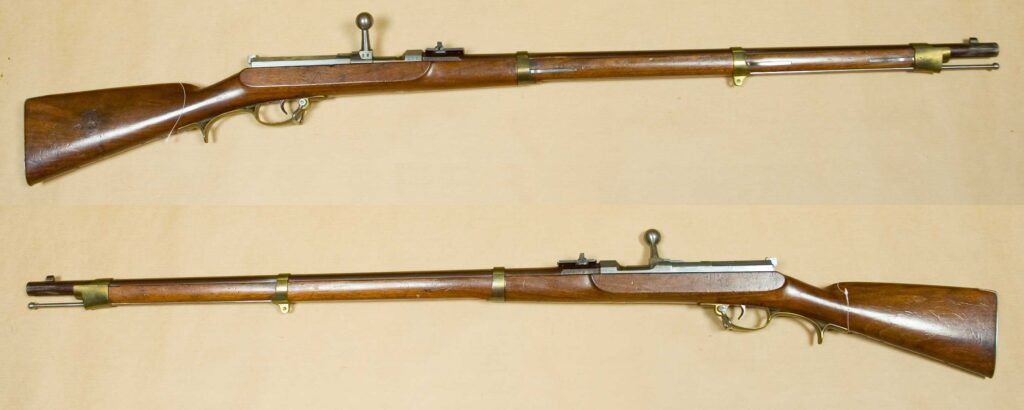
In the 1866 war, the Prussians were armed with a slightly inferior weapon, the Dreyse, and yet able to fire at an astonishing rate for the time. They conquered the enemy solely by firepower, tactics in which Moltke rigidly believed.
War at that time, as so many reports indicate, was far more complicated than in Napoleonic times.
Falling into the trap of comparison, as more than a few wargamers of my acquaintance have, is as doomed as the French pas gymnastic.
( Comments based on The Foreign Correspondent’ No 76, p19. By Dr Patrick Marder: California, 2005)
Hi Rob,
Great to hear from you! I actually provided a response to your post about firepower in the Bavarian war a couple of days ago but it appears to have disappeared somewhere into the aether! – As an aside, does the title of your post refer to a historical conflict or my current campaign – just wondering? Regardless, I found the content of your post extremely interesting.
The thrust of my original response was to see if you had any thoughts or info on the French Mitrailleuse guns, particularly on how they should have been employed, compared to how they were employed historically?
I’ve pinged JohnY to see if he can locate my missing post, but thought to send you a few quick lines in the meantime to let you know I am very interested in any thoughts you have, or references you can recommend, that talk to the development in firepower and the development of battlefield tactics in this period.
Just in case you have some spare time and nothing better to do!
Cheers
G
From Rob Morgan:
As far as the Mitrailleuse is concerned, most post 1871 accounts seem to agree that the French style of using what was undoubtedly the potential battle winner of the war, was wrong. The Mitrailleuse was not suited to ‘battery fire’, but could and should have been used as a mobile assault weapon, well forward with attacking infantry and light ordnance. It certainly could have reduced the effectiveness of Prussian musketry with ease. I’m not so sure of its potential with the cavalry of the period.
This reminds me of the fact that during his ill fated ‘campaign’, Custer had four Gatling Guns with him, but decided against using them. A real sporting gentleman.
I’d recommend Michael Howard’s history of the Franco-Prussian War written several decades ago as the best book about the war, and one which includes a some useful information about the French wonder weapon, of which only around 200 were manufactured and evaluated and deployed in total secrecy, which is what caused operational problems at all levels. ‘Wargames Illustrated’, no 77 or 78, included a short but very valuable article on the mitrailleuse in the war, written by Steve Shann, which deals with tactics and potential. You’ll certainly need that.
There have been short articles on the guns in several issues of ‘The Ordnance Society’ Newsletter, and ‘The Foreign Correspondent’ over the years, but at present I can’t climb up into my archive ( the attic)- arthritis! Do remember there were two versions of the Mitrailleuse. the 1863 Montigny which had 37 barrels and was also used by the Austrians; and the 1867 Reffye which had 25 barrels. There was plenty of debate about their respective technical features and effectiveness after the war.
Hi Rob,
Great to hear from you and many thanks for your comments on the Mitrailleuse! I was aware of the different versions of the gun the French had, but didn’t realise the Austrians also had them! That’s a key bit of info for me as I’m about to start painting my 1866-1870 Austrians, and am now intrigued by what an Austrian army armed with the lessons of 1866, along with breech loading rifles and Mitrailleuse might accomplish if (when) they join the war?!! Once again, you’ve displayed that uncanny knack of passing along info that anticipates what I was about to do!
I’ll start hunting for those Wargames Illustrated articles you mentioned.
Whilst I would love to read those Ordnance Society and Foreign Correspondent articles, I’d prefer that you didn’t do anything to exacerbate your arthritis. I was going to say that arthritis is a pain in the arse, of course you can’t get it there, but you know what I mean! It sucks mightily!!
I’ll start researching those Austrian Mitrailleuse this weekend – many thanks again for the heads-up!
Cheers
G