
by Rob Morgan
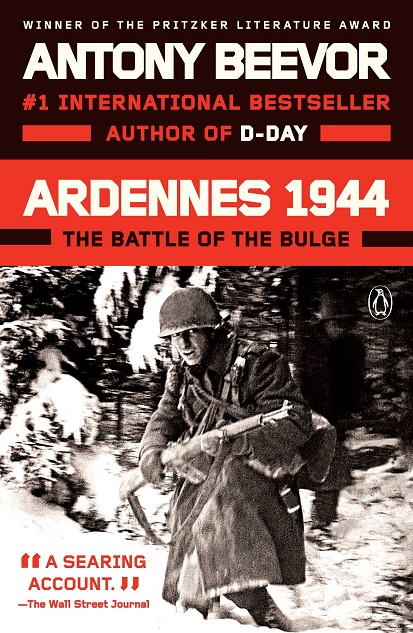
I was reading Beevor’s excellent book Ardennes 1944 : The Battle of the Bulge and on page 63, came upon a quote from an American officer in relation to the fighting in the Hurtegen Forest.
He wrote, “The effective range of rifle fire in woods and forests rarely exceeds fifty yards.”
I’d never really thought about it, as I’m mainly a naval wargamer, but the necessary adjustment to table-top rules must be significant and brings close quarter combat and hand-to-hand fighting in forests into perspective.
I suspect that more recently the immense use of automatic weapons has slightly restored the balance. But in terms of warfare, and wargaming as well, before the 1950’s and way back into the nineteenth century, woodland and forests must have attained a most effective role in disrupting volley fire, targeting, and musketry in general.
Might not affect Riflemen Jagers, and Voltigeurs, operating loosely, but the ordinary conscript foot soldier?
Anyone got any thoughts?
Trees are trees, blocking fire whatever the age of weapon
In Donald Featherstone’s Close Wars rules (an appendix to his War Games 1962 book) which was roughed out to offer a French Indian Wars game in the forests https://manoftinblog.wordpress.com/2016/06/09/close-little-wars-featherstones-simplest-rules/
There are separate movement distinctions between natives and troops in groups of three or below and groups of three and above to make a distinction between formed groups of conscript troops (who can potentially volley fire?) and loose groups of rangers, light infantry, jägers. No such distinctions are made about the varied success of rifle fire etc in these simple rules.
At a guess most rules limit range and effectiveness is woods. Even before smokeless powder target location wasn’t easy while ambush could be if those being ambushed had poor perception (eg not noticing how quiet it is as birds and animals scatter). I restrict close order troops and mounted troops to paths and clearings, riding through woods is really haarddous for horse and rider. Rapid fire weapons would increase effectiveness as short range but ammo supply could be a problem.
Using automatic weapons, almost all shots are misses. Soldiers trained with modern weapons were told to pray and spray after they got to the field. The US Army realizes that shooting accuracy is very poor and has begun emphasizing aiming before shooting but for the most part the accuracy of a modern AR in the hands of regular infantry is no better than a musket due to operator error. You can safely assume a short range for rifles in contemporary warfare. But a special operator such as a sniper should be allowed a very long range.
Yes, trees would make a difference also.
Good comments all. I’m going to limit the following to forests of North America/Europe and fighting in the 18th and 19th centuries. Forests provide both cover (protection from bullets/arrows) and concealment (difficulty being seen). The fringe of a forest or clearings within it are open to sunlight and therefore there can be considerable vegetation other than trees. Mobility is difficult as one tries to enter the forest (except for paths or stream beds). However, within the forest, where sunlight is limited, there is little ground vegetation, although there may be deadfall. Mobility for persons on foot can be pretty good. Mounted persons need to stick to paths or clearings. So, the trees provide both cover and concealment. In a meeting engagement, because so many bullets will be stopped by trees, fighting grinds on slowly. Charges can be decisive. Native warriors will nearly always fall back if charged by bayonet wielding troops.
However, in an ambush, the stationary force is both covered and concealed and selects a killing ground without cover and concealment, such as a trail, stream bed, or better yet, a clearing. I give the ambushing force a 10% chance of being discovered before they can open fire. If discovered, the ambushed force can seek immediate cover. Otherwise, the ambusher gets the first shot at an enemy pretty much uncovered. Return fire hits the trees most often. However, after the opening round, a competent force being ambushed will withdraw to cover. Conscripts may remain in place or rout, especially if leaders are casualties. Ambushes are the deadliest of engagements. So, I use a homebrew set of rules based upon “Our Moccasins Trickled Blood.” It takes these variables into account.