George ArnoldComments Off on Decision at Danville — Part 1
By Chris Hahn
Frustrated by a failed attempt to stage an adaptation of the Battle of Dettingen (June, 1743 — see the March issue of Wargame Illustrated for a very colorful narrative by the Worcester Wargames Club), I shifted my focus forward approximately 120 years to the border state of Kentucky.
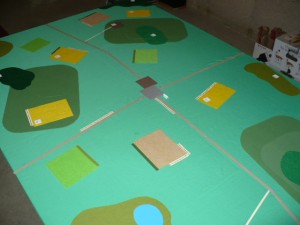
Photo A.
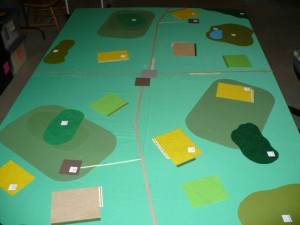
Photos A and B show how I set up the terrain for this fictional contest between Yankees and Rebels. The small village of Danville occupied the approximate center of the 6 x 4-foot playing surface. The village consisted of one stone sector and one wood sector. Two farms completed the BUAs of the battlefield. These were on opposite ends of the table and were named Magnuson’s Farm and Parker’s Farm, respectively.
The battlefield was created from foam sheets, specialty paper, and 9 x 12-inch pieces of felt purchased from Hobby Lobby or retrieved from a banker’s box marked “spare stock.”
Photo B.
While my tabletop will never be a contender for the cover of one of the British magazines (unless, perhaps, an editor decides to run a “what you don’t want your wargame to look like” theme), this flat terrain was completely functional, flexible, easy to store, and very inexpensive. Hills offered some dimension to the playing surface. The various cultivated fields were evident, as were the roads, woods, fences, stonewalls, etc.
Inspiration for this imaginary contest between Union and Confederates was taken from a number of sources. In the same issue of Wargames Illustrated, there was a pictorial report on a version of Chancellorsville. (One of the four tables used for this massive game measured 24 x 6 feet!) In the “Black Powder” rule book – the rules used for this encounter — the dynamic duo of Priestley and Johnson provide an ACW report titled “Daybreak at Hangman’s Creek.” I looked back through my beat up copy of “Fire & Fury;” I reviewed the chapters on the War of Succession in Charles Grant’s “Wargame Tactics,” and I reacquainted myself with a few chapters and the detailed orders of battle found in Larry J. Daniel’s “Shiloh: The Battle That Changed the Civil War.”
Having learned the hard lesson with Dettingen, I limited each side in this meeting engagement to two divisions of infantry, a few regiments of cavalry, and some artillery.
To make the most of my limited playing surface, I converted inches to centimeters. (This suggestion is found on page 174 of “Black Powder.”) To add a bit of additional flavor to the “tool box” approach of these rules, I borrowed a number of amendments from the house rules and adaptations established by The Contemptible Little Wargames Club. (A visit to their dedicated web site is highly recommended.)
With subsequent installments of “Decision at Danville,” I intend to report on the progress of the wargame, as well as detail how I went about creating the miniature armies.
Rob Morgan provides this month’s sample article from the pages of Lone Warrior magazine. His article is an “everything you need to know to get started” type on naval warfare during the American Civil War. Included are where to find ship models and reference material and even a set of rules. It’s on the Sample […]
Graham Empson provides this month’s article from the Lone Warrior archives. He describes solo mechanisms for setting up and running ACW games, including OOBs, leader qualities, deployment and more. It’s on the Sample Articles page.
The latest rules to be added to this blog are George Arnold’s Horse and Musket rules, with movement and combat factors for Napoleonics and for the American Civil War. They’re on the Complete Rule Sets page.